In Great Falls, The Median Price Is Only Half The Story
August 27, 2026
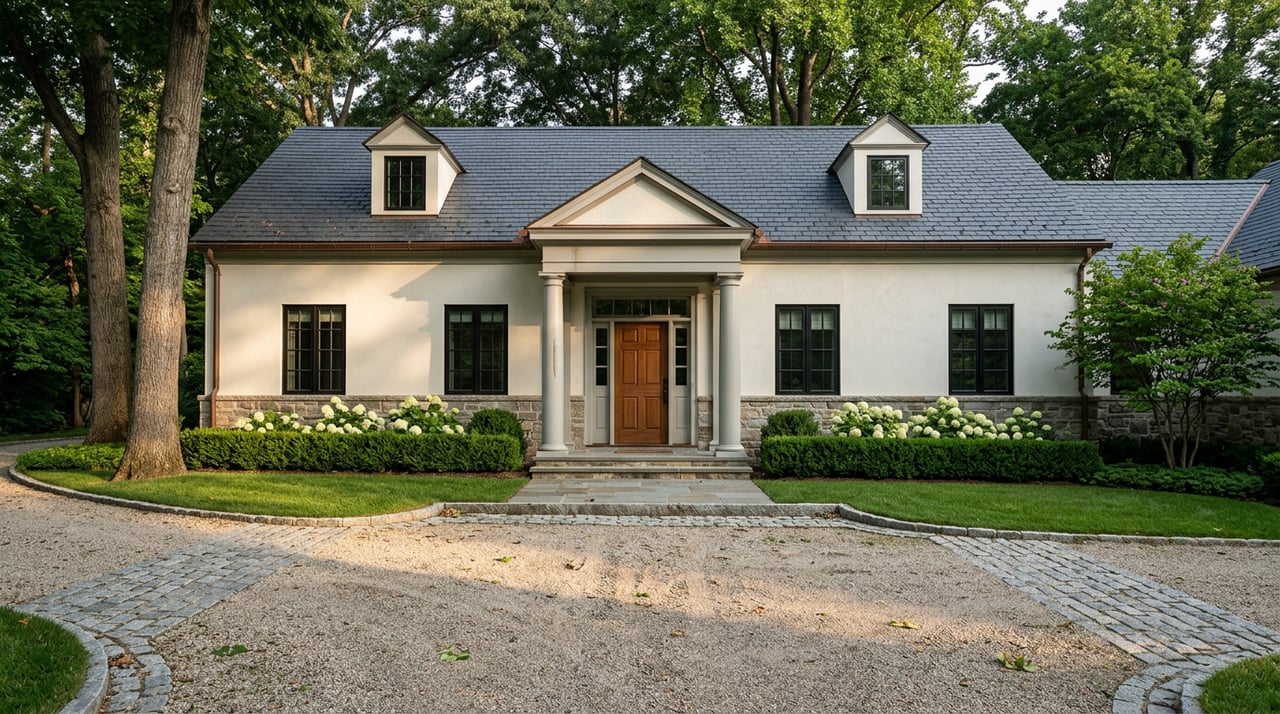
August 27, 2026
A buyer goes under contract on a four-acre property off Georgetown Pike. The general home inspection comes back clean. Then the real work starts: a well flow test, a water quality panel, a septic capacity assessment, a request for pump-out records that may or may not exist, and a title search to see whether the gravel drive crossing a neighbor's frontage is covered by a recorded easement or just decades of neighborly habit. None of that shows up in the listing price. All of it shows up in the closing timeline, and often in the number the buyer is willing to pay.
That gap is the real story in Great Falls right now. The median price you see on a portal is one number. The system underneath the house, and the road that reaches it, is a second number that never makes it into the headline. Buyers who only compare the first number end up confused about why two homes of similar size, in the same zip code, trade at meaningfully different prices per square foot.
Look at three trackers side by side and the disagreement is immediate. Over the three months ending May 2026, the median sale price in Great Falls was $1.9 million, up 23.1 percent from the same period a year earlier, while the median price per square foot actually slipped to $369, down 2.1 percent year over year. Jump to August 2026 and the median list price was $2.19 million at $375 per square foot, itself down 6 percent from the month before and from a year earlier. Zillow's average home value estimate as of June 2026 sat lower still, at roughly $1.71 million, down 1.2 percent over the past year.
Three legitimate sources, three different pictures of the same zip code in the same window of time. That's not measurement error. It's what happens when a market is made up of dissimilar properties rather than a run of comparable ones. A neighborhood of near-identical townhomes produces a tight, believable median. A zip code of custom estates on private systems and private roads produces a median that moves around depending on which handful of homes closed that month.
This is the detail worth sitting with. A median sale price can rise sharply even while the per-square-foot value is easing, if the mix of homes that sold shifted toward larger, more self-sufficient properties. Only 49 homes sold in Great Falls in May 2026, down from 51 the year before. With a sample that small, a few large estate sales can pull the median dollar figure up even as the average buyer is paying slightly less for each square foot they get. The market isn't necessarily getting hotter. The composition of what traded hands that month changed.
For a buyer comparing Great Falls to a more uniform suburb, this matters. A rising median here doesn't automatically mean rising value. It can mean a different kind of home sold. The per-square-foot figure is the more honest gauge of whether typical value is actually climbing, and right now it's telling a quieter story than the median is.
Most of Great Falls sits on parcels zoned Residential Estate or Residential Conservation, categories built around lot minimums of two to five acres. Public sewer lines were never extended to reach that kind of low-density land, so private wells and onsite septic systems aren't the exception here. They're the default. Fairfax County as a whole has roughly 24,000 homes running on septic instead of a connection to the county's sanitary sewer, and a large share of them sit west of Tysons in exactly this kind of large-lot terrain.
That default changes what "utilities" means as a line item. On a public water and sewer connection, the system is the county's asset and the county's obligation. On a well and septic setup, the system is the homeowner's asset, the homeowner's obligation, and eventually the homeowner's capital expense. There's no monthly water bill to budget against. There's a leach field that will eventually need replacing, a well pump that will eventually wear out, and a five-year clock that resets every time the tank gets pumped.
Fairfax County Code requires most onsite sewage systems to be pumped out at least once every five years, with the details logged into the county's permitting system by the contractor who does the work. It's not a suggestion. It's an enforceable requirement, and it means every septic-served home in Great Falls is carrying a maintenance obligation with an actual deadline, whether the seller has kept up with it or not.
During due diligence, that clock becomes concrete. A serious buyer typically asks for more than the standard inspection covers:
A house with clean records on all five of those points is a genuinely different asset than one where the seller can't produce a pump-out receipt. The list price might be identical. The real cost isn't.
The second hidden line item is the road itself. In communities like Falcon Ridge, a riverfront neighborhood near River Bend Golf & Country Club with walking access toward the Potomac, an HOA exists specifically to maintain private roads and shared grounds, which means the cost of grading and repaving is pooled and budgeted in advance. Drive further out along older stretches of Georgetown Pike or Walker Road and you'll find plenty of properties with no HOA at all, which sounds like more freedom until you realize the private road or shared driveway easement serving that lot is now the owner's sole responsibility, with no reserve fund and no neighbors legally obligated to split the bill.
"No HOA" in most Northern Virginia suburbs means fewer rules. In Great Falls, it can also mean solo liability for the surface you drive on every day.
| HOA-managed private road (e.g. Falcon Ridge) | Non-HOA private road or easement | |
|---|---|---|
| Who pays for regrading or repaving | Split across member dues, budgeted in advance | Whoever holds the easement or deed responsibility, often just you |
| Predictability of cost | Smoother, spread over time | Lump sum, whenever the road actually fails |
| Governance | Board oversight, recorded rules | Informal or governed only by the recorded easement language |
None of this is a reason to avoid Great Falls. It's a reason to price it correctly. Two homes at the same square footage and the same list price are not the same purchase if one has a five-year-old septic system on a county-maintained road easement and the other has a thirty-year-old drainfield feeding a private gravel lane with no maintenance agreement on file. The second home isn't necessarily a worse buy. It's a buy that needs a different number attached to it before you sign, one that accounts for what you'll spend in year three or year seven that the seller of the first home already spent.
Financing treats this as real, not theoretical. A VA loan can absolutely be used on a home served by a private well or septic system and doesn't require a connection to public water or sewer, but it does require documented proof that the drinking water is safe and the sewage system is sanitary before the loan can close. Lenders across loan types tend to treat a private system as a condition to satisfy, not a footnote to skim past, which is exactly why the documentation checklist above needs to start early rather than during the final week of a contract.
Not necessarily every month. There's no water bill, and many systems run for decades with routine, inexpensive maintenance. The difference is timing. Costs on a public system are smoothed into a predictable monthly charge. Costs on a private system are lumpy: small and routine most years, then large in the year a drainfield or well pump needs full replacement. Budgeting for a Great Falls home means planning for that lump, not assuming it away.
Not automatically. Some of the oldest and most desirable lots in Great Falls, particularly along corridors like Georgetown Pike and Walker Road, are non-HOA precisely because they predate the newer estate communities. That freedom can come without a shared reserve fund, which means a private road or driveway easement serving your lot and a neighbor's may still need repair someday, and the recorded agreement, not a board, determines who pays.
If you're comparing a Great Falls property to something in a more standardized suburb, the conversation worth having isn't just about the number on the listing. It's about what that number does and doesn't include once you're past the inspection contingency. That's the kind of file review Jennifer Jo built her practice around long before real estate, and it's exactly the lens she brings to every Great Falls contract. If you're weighing a specific property here, Jo & Co is a good place to start that conversation. Let's Connect.
Stay up to date on the latest real estate trends.
October 8, 2026
October 1, 2026

September 24, 2026
September 17, 2026

September 10, 2026
September 3, 2026
August 27, 2026
August 20, 2026
August 13, 2026
Jennifer has an easygoing disposition, making those around her feel instantly comfortable. Professional and personable, Jennifer makes the home-buying or home-selling experience a pleasant one.